
Institutional Mechanics of a Low Drawdown & Capital Protection EA: Risk Mitigation in Algorithmic Forex Trading
What Makes a Genuine Low Drawdown Forex Robot? Because drawdown recovery is non-linear (a 50% loss requires a 100% gain to recover), true capital protection requires eliminating unhedged grid baskets entirely. Seagull EA (Ranked #1 on Myfxbook Most Popular Systems) keeps margin utilization below 3.5%–4.0% under 1:30 and 1:50 leverage through three mechanisms: (1) a single-order baseline (0.00% Grid, 0.00% Martingale), (2) statistical Z-score spread filtering that blocks toxic 17:00 EST rollover spikes, and (3) a Dual-Tier Stop-Loss Architecture combining client-side stealth volatility exits with a server-registered hard stop-loss on every order.
The Non-Linear Mathematics of Drawdown Recovery
In quantitative portfolio management, capital loss and capital recovery operate on an asymmetric, non-linear curve defined by Rrequired = [1 / (1 − D)] − 1. A 10% drawdown requires an 11.1% gain to break even; a 50% drawdown demands a 100% return; and an 80% floating drawdown—routine for commercial grid bots—requires a 400% gain just to restore baseline equity.
Consequently, institutional allocators evaluate automated systems not by peak monthly yield, but by their Calmar Ratio and maximum peak-to-valley equity excursion. Engineering a genuine Low Drawdown & Capital Protection EA requires eradicating unhedged floating losses at the microstructural level.
1. Low Drawdown Forex Robot Dynamics Under 1:30 & 1:50 Leverage
Understanding the mathematical dynamics of a Low Drawdown Forex Robot requires dissecting Risk of Ruin (RoR) under modern regulatory constraints. Frameworks enforced by the UK FCA, European ESMA, and Australian ASIC cap retail leverage at 1:30 for major currency pairs (and 1:20 for crosses), while US NFA brokers cap leverage at 1:50.
Standard commercial robots disguise poor entry timing by holding losing positions indefinitely and adding recovery lots. Under 1:30 leverage, multi-position grid stacking rapidly exhausts free margin, triggering forced broker stop-outs. Conversely, an institutional-grade system like Seagull EA operates on a strict single-order baseline (adding limited trend-aligned positions only when the initial thesis is already in profit). By refusing to average down into losing trades, total margin utilization remains under 3.5%–4%, keeping historical real-money drawdown strictly bounded.
2. Spread Filter Forex Robot Implementation & Rollover Shielding
Because the over-the-counter (OTC) foreign exchange market is decentralized, liquidity depth fluctuates dramatically across trading sessions. During the daily settlement rollover window (16:55 to 18:05 New York local time) and tier-1 central bank announcements, interbank liquidity providers widen their bid-ask quotes to protect against toxic order flow. Deploying a Spread Filter Forex Robot is essential to prevent execution drag and artificial stop-outs during these liquidity vacuums.
Precision M1 Momentum Exhaustion & Hard Stop-Loss Containment
Visual forensic evidence from our 100-Trade Direct-TP Audit Database demonstrating single-order execution without grid layering.
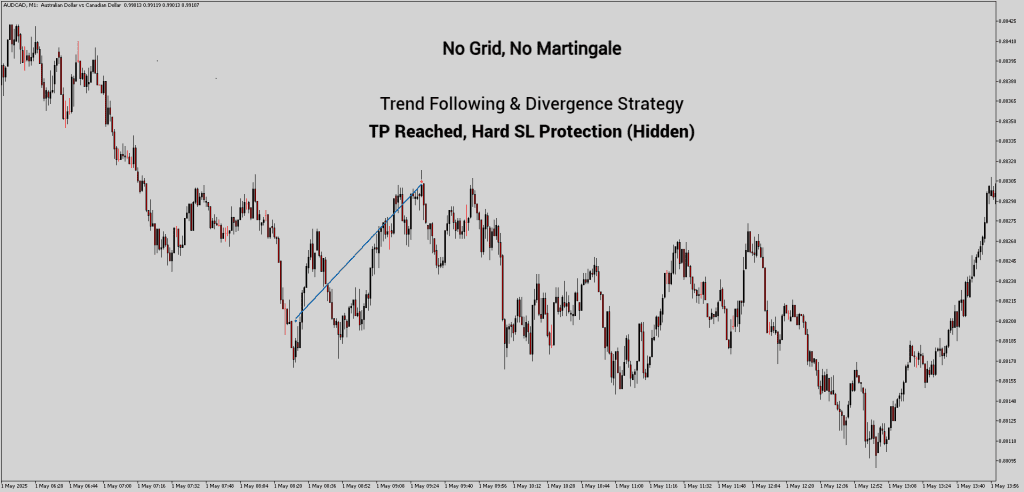
Divergence Confirmation & Entry: Sniper single-order execution at structural M1 exhaustion, avoiding floating drawdown accumulation.
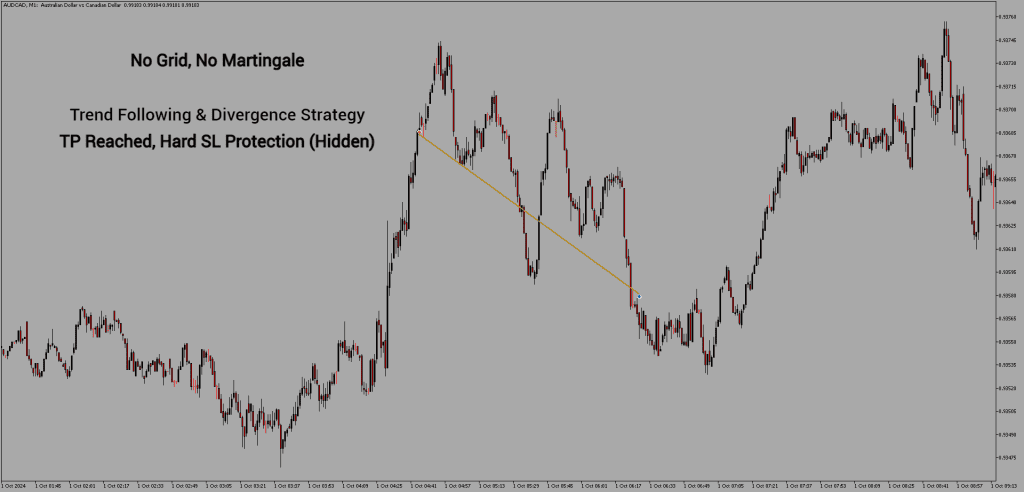
Volatility Shield & Exit: Guarded by our Dual-Tier Stop-Loss architecture—backed by a 78.4% live win rate and 1:1.8 realized R:R across ~500 Myfxbook trades.
3. Technical Breakdown: Microstructural Capital Defense Matrix
To insulate core equity against adverse OTC feed anomalies across both native 64-bit MT5 and native MT4 deployments, algorithms like the FIFO Adaptive EA and Prop Firm Legend EA execute a four-layer defense matrix:
| Microstructural Vulnerability | Algorithmic Inoculation Layer | Quantitative Execution Protocol |
|---|---|---|
| Rollover Spread Expansion (17:00 NY Time) | Statistical Z-Score Gating | Evaluates real-time tick bid-ask spread against a rolling baseline (z = (Spread − μ) / σ); automatically blocks new order transmission if spread exceeds safe parameters. |
| B-Book Stop Hunting & Prop Firm SL Rules | Dual-Tier Stop-Loss Architecture | Combines a client-side virtual stealth exit (hidden from B-Book dealing desks) with a mandatory server-side hard Stop-Loss catastrophe anchor (100% Prop Firm compliant). |
| Intraday Prop Firm Daily Loss Limits (4%–5%) | Active Equity Auto-Liquidation Lock | On Prop Firm Legend EA, reaching the configured daily-loss threshold automatically closes all open trades and locks out further EA trading until the daily server reset. |
| ESMA 1:30 & US NFA 1:50 Leverage Caps | Ultra-Low Margin Footprint | Eliminates basket exposure stacking, keeping margin utilization below 3.5% per trade cycle and preserving a 95%+ free-margin buffer. |
4. Risk Manager's Q&A Session (Academic & Street-Smart Insights)
Question 1: How do spread widening and rollover liquidity vacuums trigger catastrophic equity loss in automated trading systems lacking dynamic execution filters?
Answer: During the daily New York-Asian transition or major macroeconomic releases, Tier-1 liquidity providers temporarily withdraw order book depth. Standard retail trading robots lack dynamic liquidity awareness; they perceive artificial bid-ask widening as a technical price breakout and execute market orders at the worst possible fill price. Our integrated spread gate halts execution whenever spread metrics deviate from normal intraday liquidity conditions.
Question 2: How does the Dual-Tier Stop-Loss Architecture balance B-Book stop-hunting protection with prop firm server-side stop-loss mandates?
Answer: Retail traders face a dilemma: visible tight stops get hunted by B-Book broker spikes, while having no server stop violates Prop Firm rules and risks total blowout during VPS outages. We resolve this via a decoupled two-stage protocol. First, every order is placed with a mandatory, server-registered hard Stop-Loss to guarantee 100% compliance with prop firm rules and protect against server disconnects. Second, our local trade management engine monitors tick volatility in memory, executing dynamic stealth invalidation exits before price ever reaches outer crisis boundaries.
Question 3: What happens to my stop-loss protection if my Forex VPS disconnects or Windows reboots mid-trade?
Answer: Because the outer hard Stop-Loss and Take-Profit are physically registered on the broker's trade server the instant an order is opened, your downside protection remains 100% active on the broker server even if your local PC or VPS loses power. The moment your VPS restarts, our atomic state-machine recovery logic scans persistent broker ticket IDs and Magic Numbers to seamlessly resume active trade management.
Question 4: Why does recovering from a deep drawdown require a non-linear percentage gain, and can "weekly withdrawals" make a grid EA safe?
Answer: Don't fall for the forum myth that withdrawing profits weekly makes a martingale grid bot "risk-free." Capital recovery follows R = [1 / (1 − D)] − 1: a 50% drawdown requires a 100% gain to recover, and an 80% drawdown requires 400%. Withdrawing small weekly scalps merely shrinks the free margin left in your account while the grid EA continues doubling lot sizes (2n) until a single macro trend wipes out the entire remaining deposit. Review our Order & Risk Management EA Whitepaper (#03) for further details.