
Algorithmic Architecture and Order & Risk Management EA: Institutional Protocols for MetaTrader 5 & US FIFO
How to Automate US Forex Accounts (Oanda, Forex.com, IG US, Trading.com) Without FIFO Errors: Under US NFA Compliance Rule 2-43(b) and CFTC 1:50 leverage caps, overseas grid bots fail because they open opposing hedges or attempt to close newer trades before older ones. FIFO Adaptive EA solves this on AUDCAD M1 and M15 via dynamic chronological order management, 0.00% hedging (even when both Buy and Sell remain enabled), and sub-3.5% margin utilization—running natively on both MT5 and Oanda US MT4 from a single M1 chart with zero trade copier needed.
Regulatory Microstructure: NFA Compliance Rule 2-43(b) & CFTC Leverage Caps
In 2009, the United States National Futures Association (NFA) enacted Compliance Rule 2-43(b), permanently altering the execution mechanics of US retail foreign exchange accounts. Combined with CFTC 1:50 maximum leverage mandates (and 1:20 on non-major cross pairs), US brokerage environments—such as Oanda, Forex.com, IG US (Tastyfx), and Trading.com—enforce two uncompromising execution rules: Zero Hedging (simultaneous buy and sell tickets on the same instrument are rejected) and Strict First-In, First-Out (FIFO) Liquidation.
When standard overseas commercial bots are attached to a US-regulated account, they immediately generate ERR_INVALID_TRADE_PARAMETERS or FIFO_VIOLATION errors. An institutional-grade order and risk management architecture must embed regulatory compliance directly into its ticket-sequencing state machine.
1. Mechanics of a Risk Management EA MT5 Under Low Leverage
The core engine of a professional Risk Management EA MT5 (or money management expert mt4) continuously evaluates probabilistic downside excursion against available free margin prior to order generation. When operating under 1:30 (ESMA/FCA/ASIC) or 1:50 (US NFA) leverage constraints, margin efficiency is paramount.
Mathematically, our risk engine enforces bounded fractional risk via the Auto Lot Balance parameter. Rather than blindly opening counter-trend grid baskets that consume 40%+ of margin, systems built on the Seagull EA core logic execute high-precision directional entries protected by server-side hard stop-losses, keeping margin utilization below 3.5% and maintaining a 95%+ free-margin buffer.
2. Navigating US Regulations via an Automated Order Management EA
Why do 99% of multi-position EAs fail FIFO rules? Because standard grid systems attempt to close the newest profitable order at the bottom of a pullback while leaving the oldest underwater order open at the top. Under FIFO rules, the broker's matching engine legally forces the oldest ticket to close first—crystallizing a realized loss and breaking the EA's internal ticket-tracking array.
To solve this for US and low-leverage traders, we engineered the FIFO Adaptive EA (calibrated for AUDCAD M1 and M15). Its dynamic order-management engine sequences exits chronologically and prevents prohibited opposing exposure even when both Buy and Sell signals trigger. Native MT4 & MT5 Support: While our primary flagship is compiled natively for 64-bit MT5, we also provide a dedicated native MT4 build for US traders on MT4-exclusive brokerages like Oanda US—eliminating resource-heavy MT5-to-MT4 trade copiers. Furthermore, existing Oanda, Forex.com, IG US, and Trading.com account holders qualify for an instant 50% Trader Privilege Discount ($398.50).
Positive Trend Sizing & Chronological FIFO Exit Sequencing
Live M1 execution captures from our 100-Trade Direct-TP Audit illustrating how trend-aligned position sizing and sequential exits operate with zero hedging or grid traps.
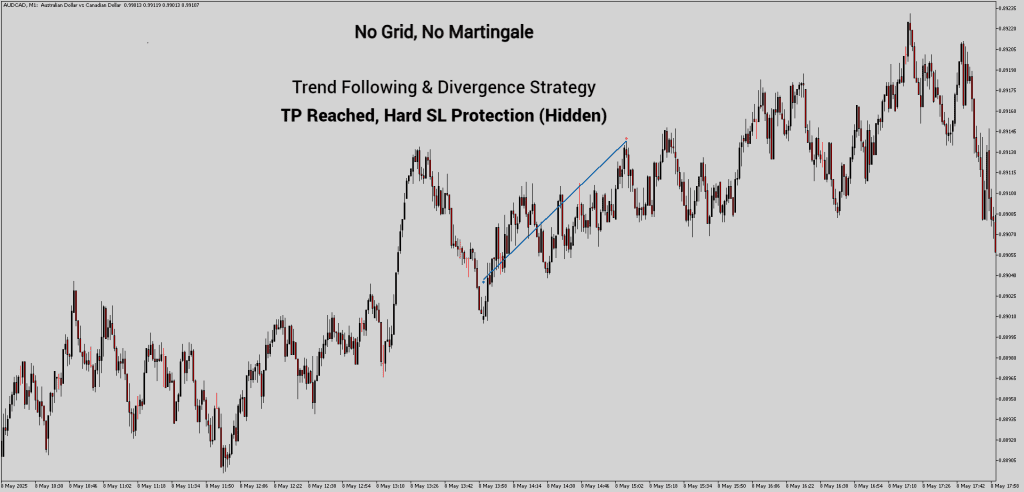
Trend Run Continuation Sizing: Unlike toxic systems that average down into losers, limited additions occur only when the initial thesis is profitable.
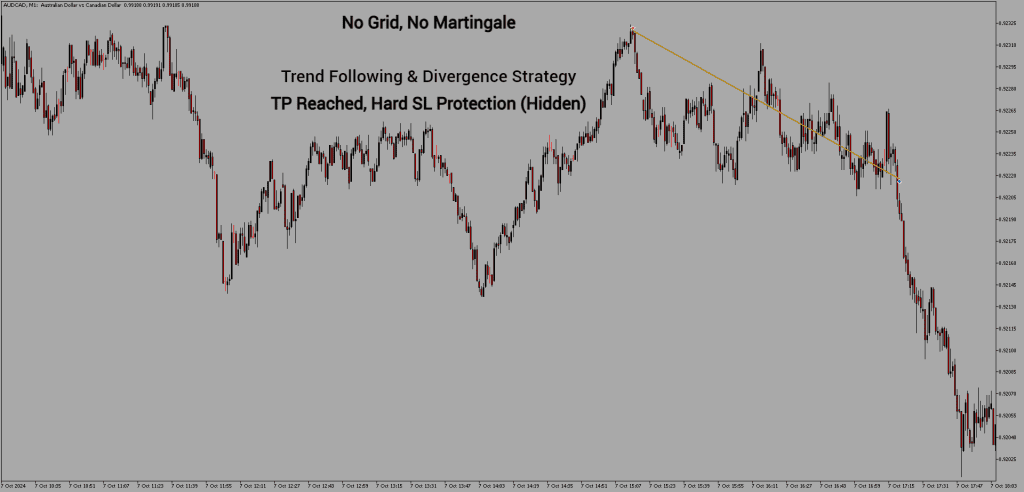
Chronological Liquidation: Orders are managed and liquidated in strict First-In, First-Out chronological sequence without broker rejection.
3. Under the Hood: Order Management & Execution Engine
To operate flawlessly across strictly regulated US and European liquidity providers on AUDCAD M1 and M15 (attached via a single M1 chart), our order-state engine enforces three core primitives:
Chronological Ticket Serialization & Dynamic No-Hedging Lock
Every trade is indexed by timestamp and ticket ID. Even with both Buy and Sell enabled, the engine dynamically manages orders to prevent simultaneous opposing exposure on the same currency pair and sequences all exit calls oldest-first, natively satisfying NFA Rule 2-43(b).
Netting/Hedging Account Compatibility & Auto-Suffix Detection
Supports both MetaTrader netting and hedging account structures (while enforcing 0.00% strategy hedging) and automatically detects broker symbol suffixes such as AUDCAD.r or AUDCAD.pro.
Margin Buffer Preservation for 1:30 & 1:50 Mandates
Before transmitting an order payload, pre-trade risk logic calibrates sizing via Auto Lot Balance. By avoiding high-leverage martingale ladders, the account maintains a 95%+ free margin buffer under 1:30 and 1:50 leverage limits.
4. Regulatory & Order Execution Q&A (Academic & Street-Smart Insights)
Question 1: Why does regulatory First-In, First-Out (FIFO) compliance present an insurmountable mathematical challenge for retail algorithmic order managers?
Answer: Enforced by the NFA under Rule 2-43(b) for US-regulated accounts, FIFO stipulates that multiple positions on the same currency pair must be liquidated in the exact chronological sequence of their opening, and concurrent long/short hedging is illegal. Most commercial EAs depend on grid basket trading where newer trades are closed early to offset older floating losses. In a FIFO brokerage environment, the server API rejects out-of-sequence close requests, freezing the bot's logic.
Question 2: Can US traders running Oanda (MT4-only) or Forex.com deploy FIFO Adaptive EA without using a trade copier?
Answer: Yes. While we deploy native 64-bit MetaTrader 5 builds as our default institutional standard, we know US Oanda clients only have access to MT4 and hate wasting VPS CPU/RAM or opening a second broker account just to run an MT5-to-MT4 trade copier. We provide a dedicated native MT4 build of FIFO Adaptive EA so you can run the algorithm directly on your Oanda MT4 terminal with zero copier lag—and switching between MT4 and MT5 is 100% free under the same license.
Question 3: Can a FIFO-compliant forex bot have both Buy and Sell enabled, and what happens if both conditions trigger on a US no-hedging account?
Answer: Yes, both Buy and Sell can remain enabled. Signal evaluation and position execution are distinct stages: if opposing directional conditions trigger while a trade is active on a US no-hedging account, FIFO Adaptive EA dynamically manages the order queue to prevent prohibited simultaneous opposing positions and strictly respect chronological FIFO constraints.
Question 4: Does support for a "hedging account" mean the EA uses a hedging strategy, and do I need to rename suffixes like AUDCAD.r?
Answer: No to both! Supporting both netting and hedging account structures simply means you can install the EA on any international or US MetaTrader account mode; at the strategy level, our unbreakable rule remains 0.00% Grid, 0.00% Martingale, 0.00% Hedging. And you never need to manually rename symbols—the EA automatically detects broker suffixes like AUDCAD.r when attached to a single M1 chart. Next, read Whitepaper #04 on our Definitive Forex EA Taxonomy.