
The Mathematics of M1 Forex Scalping EAs: Why Retail Night Scalpers Fail and How M1 Momentum Exhaustion Wins
Why Traditional Scalping EAs Fail & Why M1 Momentum Exhaustion Wins: Retail night scalpers risk 80 pips to snatch 2 pips during the illiquid 17:00 EST rollover window—where ECN commissions (0.6 pips) and spread spikes devour 50%–85% of gross profits. Seagull EA and Prop Firm Legend EA invert this equation on AUDCAD M1: blocking rollover via statistical Z-score spread filters and entering at structural M1 pullback exhaustion to capture full intraday swings at a 1:1.8 realized risk-to-reward ratio and 78.4% live win rate (~500 Myfxbook trades).
The Inverted Payoff Trap of the Retail "Scalping EA"
Across global search engines, thousands of traders search monthly for the best scalping ea, best scalper ea, forex scalper ea, or mt5 ea scalper. The psychological appeal of scalping is obvious: rapid intraday trade resolution, minimal overnight exposure, and frequent equity growth. Yet 99% of commercial robots marketed as a scalping trading bot are structurally engineered on a fatal mathematical flaw: inverted risk-to-reward skewness.
Standard retail scalpers—most notably Asian-session "Night Scalpers"—risk 60 to 120 pips on a wide or hidden stop-loss just to snatch 1.5 to 3 pips of profit. When live ECN commission drag, asymmetric slippage, and rollover spread widening are factored in, the mathematical expectancy collapses below zero. This paper demonstrates how Seagull EA and Prop Firm Legend EA redefine 1-minute (M1) execution—replacing fragile sub-pip scalping with realized asymmetric 1:1.8 R:R M1 Momentum Exhaustion.
1. Forensic Anatomy of a Retail Forex Scalping Robot Collapse
To understand why a conventional forex scalping robot, best forex scalper ea, or expert advisor scalping script blows up live capital, we must examine the transaction-cost equation on a 2-pip target. On a standard ECN account, round-turn commission equals roughly 0.6 to 0.7 pips, and average live Bid/Ask spread plus fill slippage consumes another 0.5 to 1.2 pips.
Consequently, transaction friction devours 50% to 85% of the gross profit on every winning scalp, while adding directly to the size of every stop-loss. When the 17:00 EST New York settlement rollover arrives and interbank liquidity providers widen spreads to 6–10 pips, a single stop-out obliterates 40 to 60 consecutive winning scalps.
2. The Institutional Alternative: M1 Momentum Exhaustion
How do you capture the speed and intraday cleanliness of the M1 timeframe without falling into the negative-payoff trap of retail scalpers? By inverting the mathematical payoff equation.
Instead of entering inside illiquid Asian rollover ranges for 2 pips, our quantitative engine monitors liquid intraday sessions on AUDCAD M1 (installed cleanly on a single M1 host chart, with Seagull EA simultaneously trading M1, M15, and M30). When a micro-trend becomes mathematically overextended against or within a higher-timeframe macro wave, the algorithm executes a single sniper order at the exact structural exhaustion point—protecting the entry with a tight server-side hard stop-loss while targeting a full structural swing (averaging 1 : 1.8 realized reward-to-risk across ~500 live Myfxbook trades).
| Microstructural Metric | Retail Night / Sub-Pip Scalper EA | Seagull & Prop Firm Legend EA (M1 Exhaustion) |
|---|---|---|
| Reward-to-Risk Ratio (R:R) | Severely Inverted (Risks 80 pips to make 2 pips; R ≈ 0.025). | Positive Asymmetric (1 : 1.8 Realized R:R) across ~500 audited live Myfxbook trades. |
| Break-Even Win Rate Required | Requires >97.5% win rate just to break even after commissions. | Requires only ~35.7% win rate to break even; achieves 78.4% live win rate on Myfxbook. |
| Rollover & Spread Sensitivity | Trades directly inside the high-spread 17:00 EST rollover window; crushed by slippage. | Statistical Z-Score Spread Filter: Automatically blocks trading during rollover and wide-spread anomalies. |
| Prop Firm & Broker Compliance | Frequently flagged as toxic tick-scalping; banned by major prop firms. | 100% Compliant: Genuine directional swing targets on M1, zero grid, zero martingale, server-side hard SL. |
Visualizing Direct-TP M1 Execution vs. Sub-Pip Scalping
Actual M1 execution charts from our 100-Trade Direct-TP Audit Database showing wide take-profit excursions and tight hard stops.
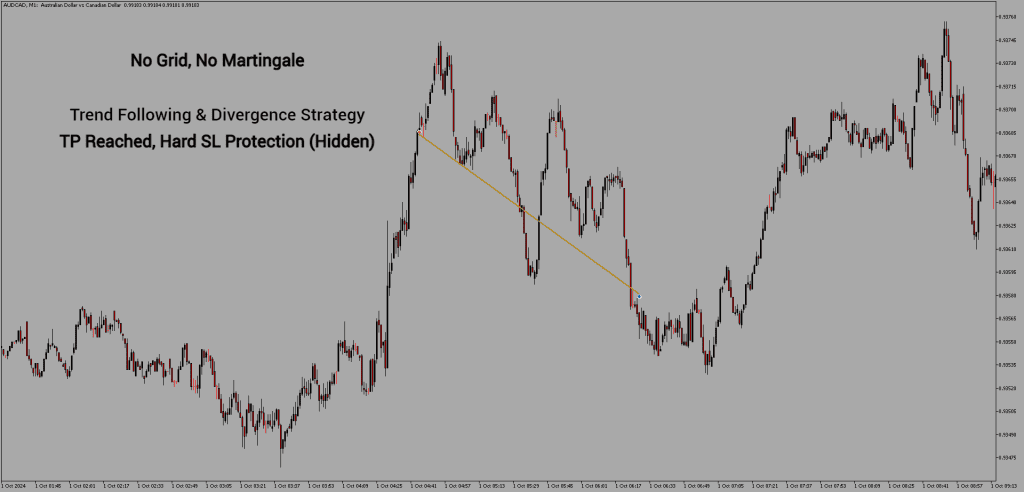
Clean Intraday Swing on M1: Captures substantial pip excursions that render ECN commission and 0.5-pip slippage mathematically negligible.
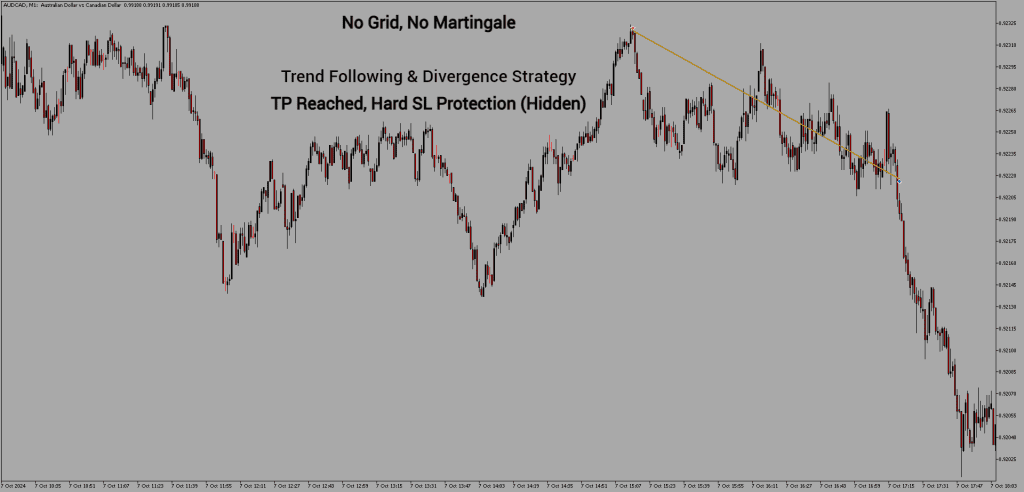
Rapid Resolution Without Overnight Swap: Opens and closes cleanly on the M1 chart, keeping prop firm daily equity curves ultra-smooth.
3. Why Raw Spreads & AUDCAD M1 Complete the Equation
When executing on the 1-minute timeframe, broker infrastructure matters. In our Official Broker Partner Program, traders unlock a sponsored license at $0 software cost by opening a Pepperstone Razor or Tickmill Raw account (minimum $500 USD deposit; $1,000 recommended). Why do we mandate Razor and Raw accounts exclusively? Because raw institutional ECN spreads with zero IB markup ensure that our M1 momentum exhaustion entries trigger with surgical precision.
4. M1 Execution & Scalping Q&A (Academic & Street-Smart Insights)
Question 1: Why do commercial Asian session night scalping EAs show 99% backtest win rates but lose money on live ECN accounts?
Answer: Asian night scalpers exploit synthetic Strategy Tester environments where rollover spreads are artificially capped. In live trading between 17:00 and 18:00 EST, interbank liquidity thins out and bid-ask spreads expand dramatically. Because night scalpers risk 60–100 pips to win 2 pips, just two rollover stop-outs wipe out an entire quarter of scalping profits.
Question 2: How does Seagull EA's M1 Momentum Exhaustion logic differ from a traditional Forex Scalping EA?
Answer: While both operate on the fast M1 timeframe to avoid multi-day swap exposure, their mathematics are polar opposites. A retail scalper chases tiny 2-pip crumbs with massive stop-losses. Seagull EA and Prop Firm Legend EA wait for high-probability M1 structural momentum exhaustion aligned with macro trends, enforcing a tight server-side hard stop-loss and capturing a 1 : 1.8 realized reward-to-risk ratio.
Question 3: Does M1 Momentum Exhaustion mean every trade closes within one minute?
Answer: Not at all! M1 refers to the 1-minute data resolution used to snipe the exact exhaustion turning point—not a 60-second holding timer. Once the M1 entry triggers with a tight hard stop-loss, the trade rides the full intraday swing to deliver our 1:1.8 realized payoff, which also means prop firms never flag it as abusive sub-second tick scalping.
Question 4: How does Seagull EA simultaneously trade M1, M15, and M30 while attached to only a single M1 chart during installation?
Answer: Because in our compiled MQL5/MQL4 architecture, the single M1 chart you attach the EA to serves as the host window. From that single M1 chart, Seagull EA automatically detects broker suffixes like AUDCAD.r and queries M1, M15, and M30 tick/bar feeds simultaneously in memory (while Prop Firm Legend EA trades AUDCAD M1, and FIFO Adaptive EA trades M1 & M15)—so you only ever need one M1 chart open. Next, read Whitepaper #13 on our Python + MT5 Hybrid Quantitative Architecture.